
Which mode for which age
Simple from about eight, Advanced from about ten, and Expert when they ask for formulas. The mode changes what is shown, never what is possible.
What a mode is
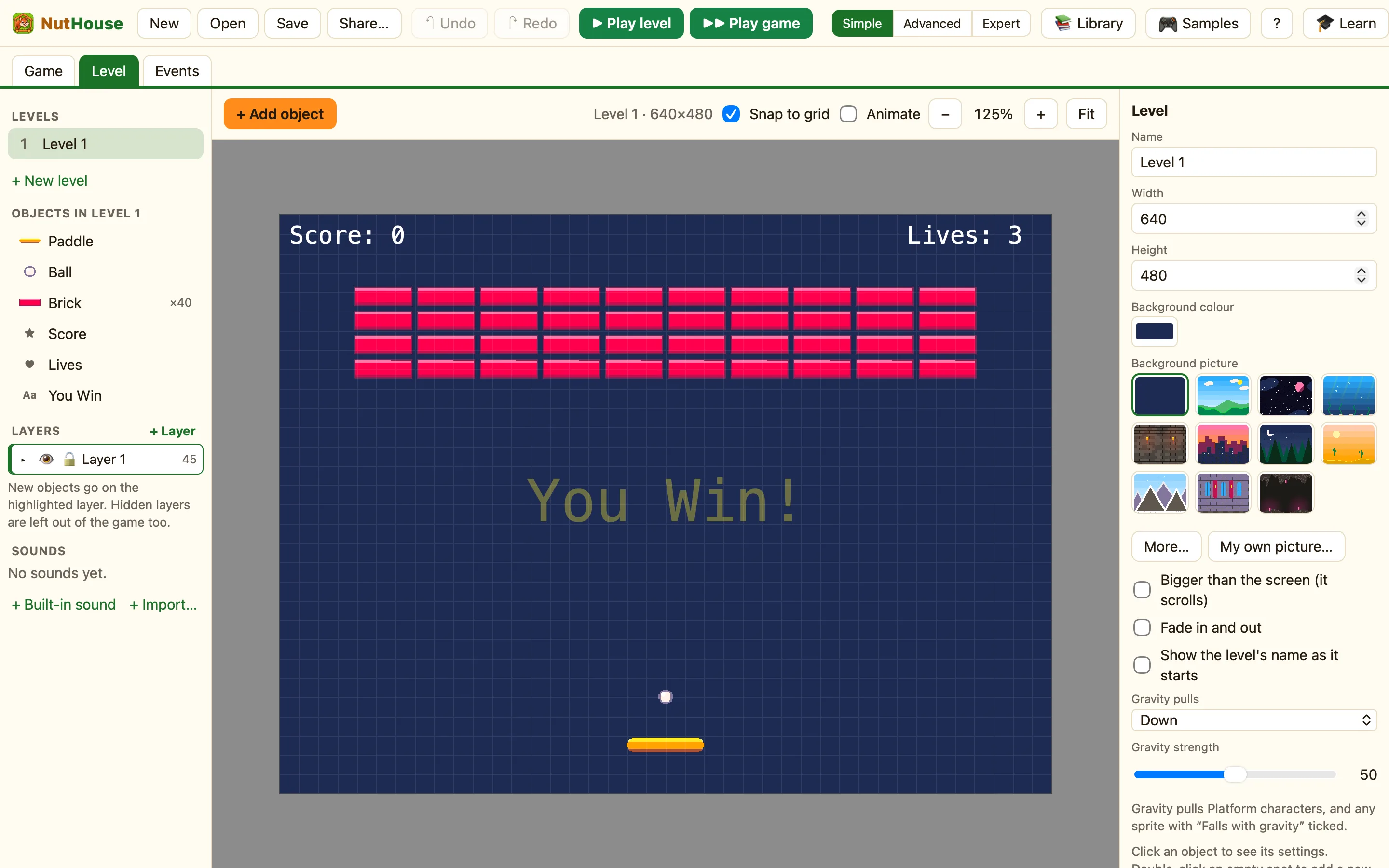
A mode is a filter on the interface. Simple shows the main pieces. Advanced adds more conditions, movements and object kinds. Expert shows everything, including formulas, values, switches and groups that switch on and off. Nothing a child has made is ever hidden: a rule using an Expert condition still shows in Simple. Changing mode never changes the game.
A rough guide
| Simple, about 8+ | Sprites, blocks, score, lives, text, buttons, questions, spawners. The six main movements. Collisions, keys, timers, the gates. Enough for every sample except the 3D one. |
|---|---|
| Advanced, about 10+ | Adds 3D levels, counters, health bars, text boxes, racing cars, first-person, paths, mouse-following, saving games, global values, and the ƒx formula box. The point where “it should do this when” becomes “it should do this by this much”. |
| Expert | Adds values and switches on every copy of a sprite, group on/off, 32 directions, hot spots. For a child who asks “can each enemy have its own health?” or wants a formula like X("Hero") - 20. |
Signs it is time to move up
- They ask for something and you cannot find it in the picker. It is probably in the next mode.
- They are writing the same rule several times with different numbers. Formulas and values do that in one rule.
- They open a sample and a chip shows a condition they cannot add themselves.
Signs to stay put
The picker feels crowded. They scroll past things without reading them. They are happy. Simple mode can make a complete, polished game with menus, sound and several levels. There is no prize for Expert.
For what each mode hides, see Simple, Advanced and Expert.
